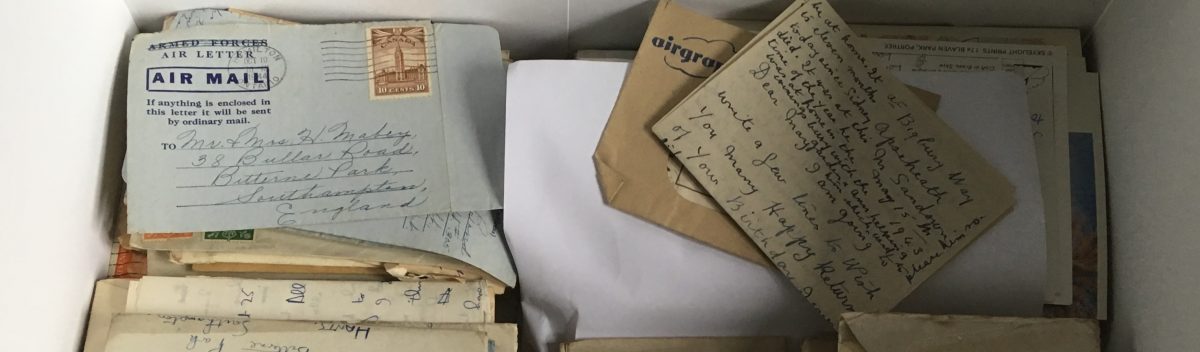
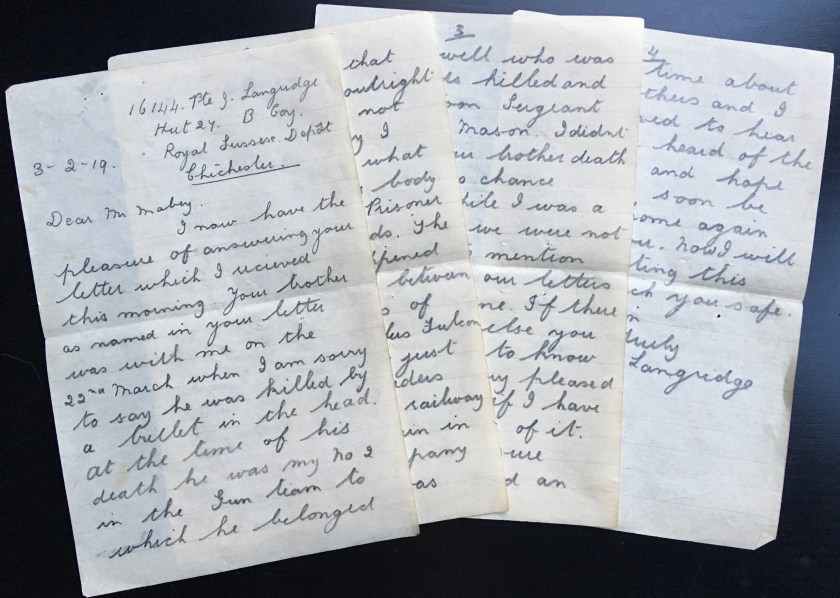
This week it is Private J. Langridge’s turn to speak to us, a very different letter to last week’s. He gives us an account of 22 March 1918, entire and plainly stated, which brings Lloyd’s life-story to a close. Yet in spite of its content this letter moved me less than Mrs Dawson’s, for hers was heartfelt whereas this letter from Lloyd’s comrade is written out of duty.
Private J. Langridge writes from Hut 27 B Company, Royal Sussex Depot, Chichester one February morning in 1919. Using a regulation pencil and regulation paper he replies to my grandfather’s letter. The military man answers the enquiry directly, ‘he was killed by a bullet in the head’. A plain, hard fact that no family wishes to know. Did Grandfather’s hand tremble, seeing the words that extinguished all embers of hope? Did Grandfather sense the thinness of these lines “I feel quite sure he was killed outright and that he did not suffer” – a form of words surely? In those times families seeking information from the military would receive a sanctioned reply, devoid of recounts of misery, failure, pain. I surmise (but cannot say for certain) that there were many letters written containing exactly those lines. J. Langridge troubled to write a four page letter in his laboured hand, troubled to detail why he could not report Lloyd’s death – so he was a good man, a survivor of bloodshed and battles that I do not wish to imagine.
Dear Mr Mabey,
I now have the pleasure of answering your letter which I received this morning.Your brother, as named in your letter, was with me on the 22nd March when I am sorry to say he was killed by a bullet in the head. At the time of his death he was my no. 2 in the Gun team to which he belonged. I feel quite sure that he was killed outright and that he did not suffer. I am sorry I cannot tell you what happened to his body as I was took prisoner shortly afterwards. The sad affair happened on the 22nd March between the two villages of St Emile and Villers Falcon about one o’clock just after we had orders to retreat from a railway cutting. Our captain in charge of the company at that time was Capt. Powell who was afterwards killed and the Platoon Sergeant was Sgt. Mason. I didn’t report your brother death as I had no chance whatever while I was a prisoner as we were not allowed to mention anything in our letters in that line. If there is anything else you would like to know I shall be very pleased to answer it if I have and [sic] knowledge of it. I feel quite sure you have had an anxious time about your brothers and I am pleased to hear you have heard of the other one and hope he will soon be back home again with you. Now I will close trusting this will reach you safe.
I remain, Yours Truly, Pte. J. Langridge

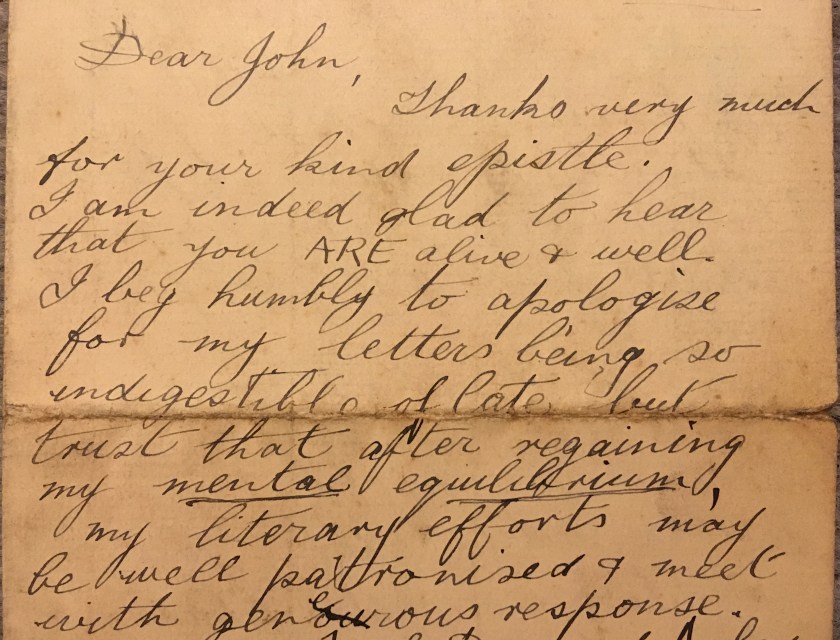 My Great-Uncle replies to my Grandfather’s letter in March 1912. He has left The Island. This is a letter full of puzzles, which no-one living can solve for me. I know that Edie and Elsie were the older Mabey sisters but why and where did they meet with Lloyd? I will never know who “Daisy of Ashey” was, nor what she knew of Lloyd’s state of mind. The 1911 Census records Lloyd as living at home and working as a nurseryman. One year later he is 19 and in West London; there are no clues to the cause of this separation. Lloyd chides my Grandfather for ‘certain practices’ suggesting something sexual and not entirely wholesome. It seems my Grandfather has given him unwanted advice about finances that still smarts – “That is hardly my nature.” Yet Lloyd wishes still to impress his scholarly older brother, for he writes that he will be submitting an article to ‘John Bull’ the following week, although he alludes no further to its subject matter. I wonder if he felt too shy to give details, or maybe there was no article to speak of.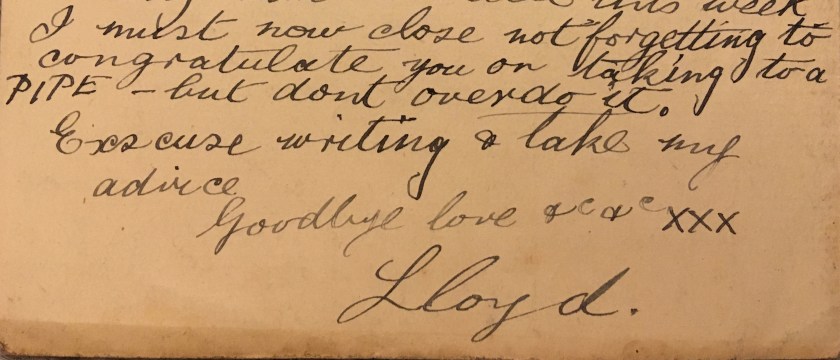
 The Letters