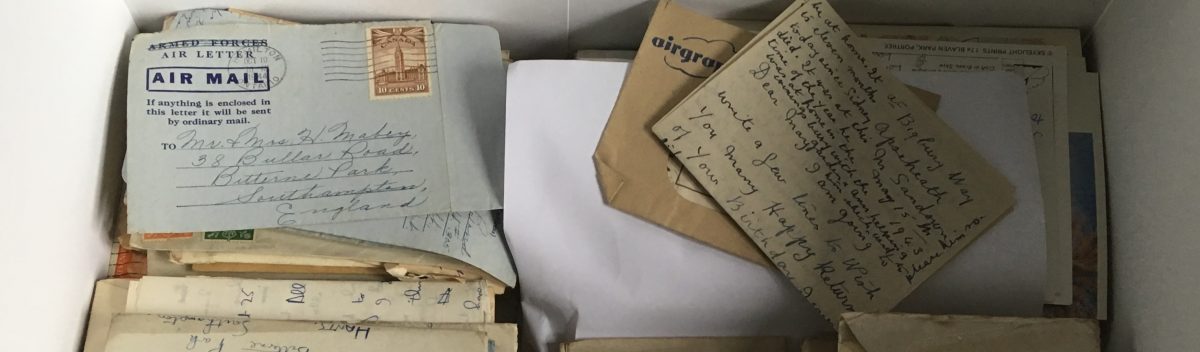
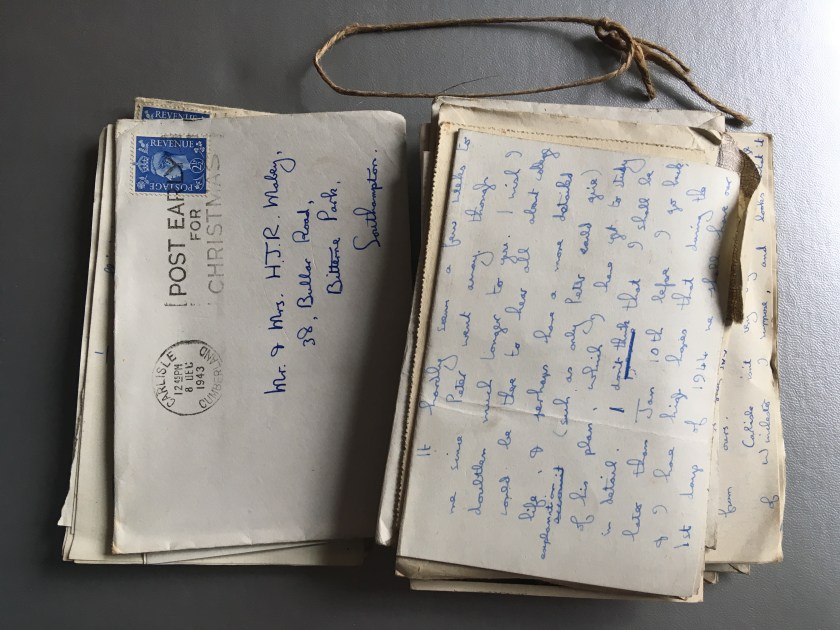
I mentioned in These Letters that many of my Uncle’s letters did not have complete dates, in fact most do not show the year. It’s not a problem if the letter is snuggled in an envelope, as the postmark will do the job, but there are many that have survived loose, so for example ‘Sunday February 28th’ is all I have to go on.
Oh the wonders of the internet! I can, with a few clicks, search the calendars of 1941, 1942 and 1943 and pinpoint the year for each letter Albert wrote. It has taken me about an hour to go through 50 or more letters. February 28th fell on a Sunday in 1943, in case you wanted to know!
Filling in the missing years to sequence the letters in chronological order would have been an impossible task without access to the ‘universal brain’, which we seem ever more reliant on. Being the age I am, I feel ambivalence about the virtual world that we collectively stride ever deeper into – because for most of my life I have lived without it. The library used to be my place to find things out, and I recall many contented hours searching for information in reference sections. I show my age when, asked how I decided to retrain as a speech and language therapist, I say I went to the careers section in the library and read about it. It sounds quite archaic!
I have not been to a library in over a decade, for I have no need. So libraries, deemed no longer ‘necessary’ by us former patrons, have lost their status in society. By eschewing their primary service I forgo their secondary free benefits: peace, a comfortable chair and a magazine to read, some friendly faces, acknowledgement, warmth, and a sense of being in a safe place in the outside world. I have no need of these things now, my home, my friends and my occupation provide all of the above. But in later, more isolated years, will there be any libraries left for me to visit when I need a change of scene?
I procrastinate; Albert’s letters lie waiting and I look at them and feel cowed by the task. This is all there is of Albert. Can I do him justice? I have wondered about him ever since I was a child. Only ever wondered, for I knew I could not ask my Mother. If ever I picked up his photograph that stood on the chest of drawers in my parents’ bedroom, she was quick to chide me with a look. ‘That’s my brother’ she would say, her expression underlining that no more would be said. Mother would make herself more busy and I understood I was to occupy myself with something less contentious. In my childhood adults still talked about ‘The War’ and I learnt a fair bit about it, but one would think nobody died, in spite of the bombs that fell on Southampton and my father’s 6 years of service. Death was not to be spoken about.
Back then my parents deemed that Albert was not a subject that their daughter needed to know a thing about. Not so now, now I can do as I please. It’s a notion on which I have floundered; what do I want from this process of opening up the bundles of letters and publishing them in this virtual world? It is to let him speak again. To have as many living souls as I can muster listen to his words, and know that he was in the world.


